The Las Vegas Metropolitan Police Department Small Unmanned Aerial Systems program uses sophisticated drones equipped with thermal imaging, AI navigation, and real-time video launched from specialized vehicles and soon from rooftop “Sky Port” hubs to support faster, smarter responses. Drones integrate with gunshot-detection and license-plate systems, and can fly beyond visual line of sight (BVLOS) […]
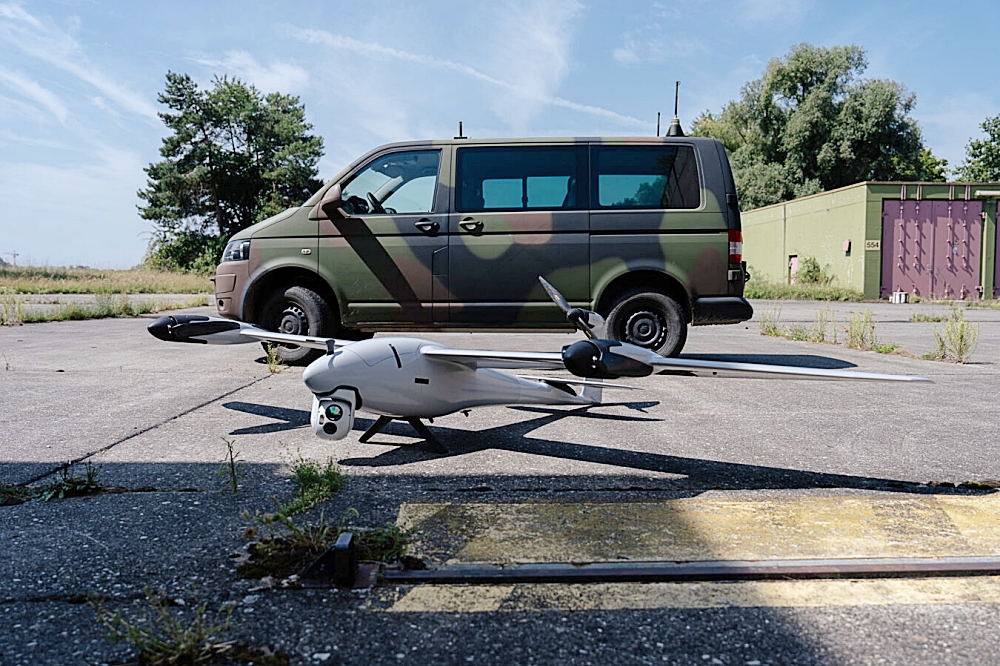
Originally developed by the German drone manufacturer Quantum Systems as a long-range reconnaissance drone, the Reliant is apparently being developed into a drone carrier. This is at least suggested by an exhibit from Quantum Systems (QS) at the AUSA trade fair currently taking place in Washington. In addition to the QS reconnaissance drones Reliant, Vector, […]
New AI capabilities and platform upgrades aim to improve accuracy, automation and safety DroneDeploy announced major product innovations at the Horizons 2025 conference in San Francisco. The company says the new solutions will improve how field teams capture and analyze data in construction, energy, utilities and industrial environments. Mike Winn, CEO and co founder of […]
Arrive AI and Ottonomy launch fully autonomous medical deliveries at Hancock Regional Hospital Hospitals must always look for new ways to reduce cost and improve patient care. At Hancock Regional Hospital in Greenfield, Indiana, staff are now getting help from ground robots and smart delivery units that work without direct human interaction. The new system […]
Spherical and compact payloads bring AI and situational awareness to public safety and defense missions Gremsy and Teledyne FLIR OEM have announced a new collaboration that brings Thermal by FLIR technology to Gremsy’s latest equipment options for commercial and government operators. The integration enables drones to capture thermal data for missions that need real time […]
New product line supports growing drone spray systems for solar, glass, and industrial cleaning Cleaning tall buildings and massive solar farms has always been hard. Workers have had to climb, spray, and scrub while carrying equipment. Drone technology is changing how companies approach cleaning tasks. Chemitek now offers cleaning products made to work with drone […]
Since peaking in 2021, drone industry funding has plummeted. And yes, that comes with plenty of bad news. Just don’t panic yet. There’s good news too, and drone companies are finding ways to thrive without the venture capital fire hose.
Let’s start with the bad news. Not only is drone industry funding sharply down from its 2021 peak, but drone companies are feeling the hit. A Drone Industry Insights survey of nearly 800 people in the drone industry, conducted in mid-2025, asked what the biggest challenges facing the industry in 2025 were.
“Acquiring industry funding” was the third biggest challenge. That’s especially notable considering it only ranked eighth in 2023 as the biggest challenge.
Graphic courtesy of Drone Industry Insights
In 2025, the only two things that ranked higher were regulatory obstacles and client acquisition. That’s all according to DII’s Global State of Drones 2025 report.
Drone industry funding in 2024 hit lows not seen since 2018, and 2025 drone industry funding is shaping up to not fare much better. More staggering is the drop-off.
To understand the magnitude of the shift, consider this: From 2019 to 2020, and again from 2020 to 2021, investment in drone companies doubled each year. Drone industry investments peaked in 2021 at $3.67 billion.
But the party came to an abrupt end in 2022, when both total funding value and number of deals involving drone companies decreased for the first time. By 2024, investments in drone companies fell to just $820 million.
Graphic courtesy of Drone Industry Insights
The Drone Industry Insights survey identifies 2021 as marking “the peak of drone market investments,” and notes that “despite a strong decline in funding since then, the overall development remains relatively robust.”
That last part phrase — “relatively robust” — deserves attention. Because while the money has dried up, the industry hasn’t collapsed. Companies are surviving, and some are even thriving. How?
Consider interest rates
Understanding the funding freeze requires understanding the broader economic context. The survey report notes that “a period of high interest rates began in July 2022. This heralded a venture capital crisis among drone companies, resulting in a period of intense market consolidation that continues to this day.”
And what we have now? The actual market for drone services and products is growing — it’s the speculative investment that’s contracted. When interest rates were near zero, investors could afford to bet on long-shot moonshots. When rates rose, they demanded quicker paths to profitability. What we have today are companies like DroneDeploy, which announced it had reached break-even in September 2025.
How drone companies are shifting resource allocation
DII’s September 2025 survey asked companies about their top priorities for resource allocation. Marketing and sales continues to consume about a third of resources (29% in 2025, down slightly from 31% in 2024), but funding has become a much higher priority.
What’s particularly telling is how different types of companies prioritize funding. According to the survey data, drone service providers (DSPs) put the highest priority on funding at 20%, while component manufacturers show the lowest need at just 9%.
Graphic courtesy of Drone Industry Insights
Presumably, component manufacturers have simpler business models with clearer paths to revenue. Service providers, meanwhile, need capital to scale operations across multiple locations and acquire equipment before they can generate returns.
The silver lining for the drone industry
While the drone funding freeze is painful, it’s forcing the industry toward sustainability. Companies that survive this period will have proven business models, actual customers and realistic unit economics. The hype-driven “fake it till you make it” era is over.
DII’s survey’s findings support this interpretation. Despite the funding challenges, expectations for market growth remain positive. The industry’s overall development score increased slightly from 6.1 to 6.8, and expectations for the next 12 months rose from 6.8 to 6.8.
Different segments are experiencing this differently. Drone software providers are “the big winner,” with their development score increasing to 7.2 and expectations for the next 12 months reaching 8.0. Meanwhile, drone integration and engineering companies—which often require significant upfront capital—experienced the sharpest decline.
What’s next for the industry amidst lighter drone funding
So how are drone companies actually surviving without venture capital fire hoses? The survey and broader industry trends point to several strategies:
Focus on cash flow: Companies are prioritizing paying customers over user growth. Revenue today beats the promise of revenue tomorrow.
Strategic partnerships: Rather than trying to do everything in-house, companies are partnering with established players who have distribution channels and customer relationships.
Lean operations: The days of lavish office spaces and rapid hiring are over. Companies are staying small and focused.
Geographic expansion: Rather than raising money to scale nationally, companies are proving the model in one region and then carefully expanding.
Specialized applications: Instead of trying to be everything to everyone, successful companies are going deep in specific niches where they can command premium pricing.
I also predict that this drone funding ‘freeze’ isn’t temporary, but rather a reset to more sustainable norms.
For entrepreneurs entering the drone space, this doesn’t have to be devastating news. Yes, getting funded is harder. But that means less competition from well-funded competitors with unsustainable business models. The companies that win will be those that solve real problems for customers willing to pay, not those that raised the most money.
The Great Drone Funding Freeze is painful, but it’s also purifying. The industry that emerges will be built on revenue, not runway. And that’s how sustainable industries are built.
Schiebel’s latest product, the CAMCOPTER S-300, was at ADEX 2025 in Seoul, South Korea. The airframe on display at the airshow was the first pre-production unit. The CAMCOPTER S-300, a larger version of the CAMCOPTER S-100, was first teased by Schiebel at Euronaval 2022. The rotary wing unmanned aerial vehicle (UAV) is 4.8 meters long, […]
– Skyways, designer and manufacturer of long-range autonomous unmanned cargo aircraft, has demonstrated the unmatched ability of its technology to deliver time-critical supplies in one of the world’s toughest operating environments. In partnership with RWE and Skyports Drone Services, Skyways successfully completed historic beyond the visual line of sight (BVLOS) drone deliveries to Arkona Offshore […]

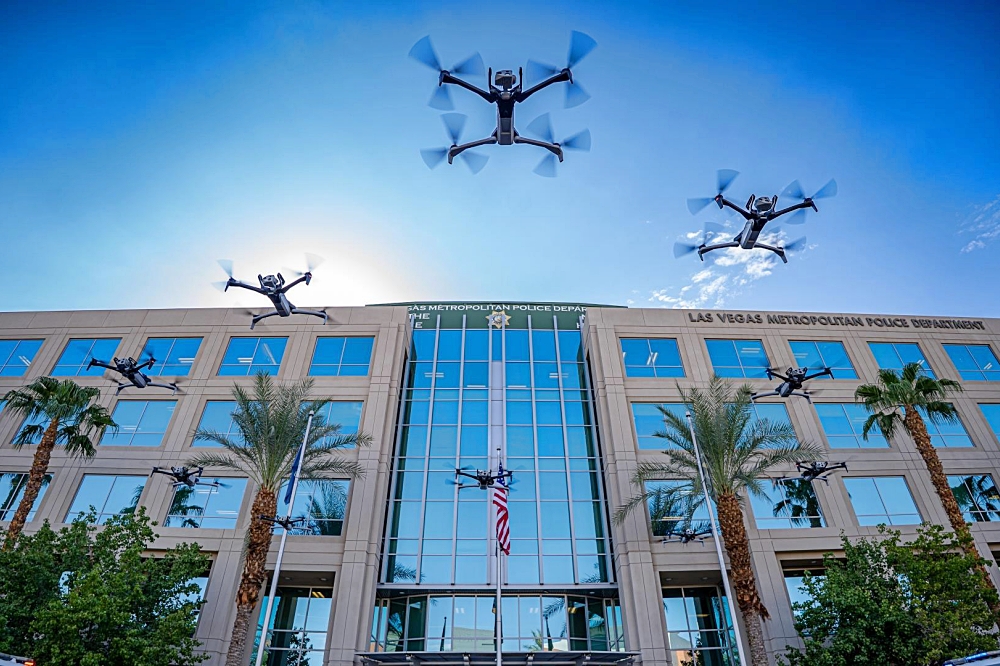 The Las Vegas Metropolitan Police Department Small Unmanned Aerial Systems program uses sophisticated drones equipped with thermal imaging, AI navigation, and real-time video launched from specialized vehicles and soon from rooftop “Sky Port” hubs to support faster, smarter responses. Drones integrate with gunshot-detection and license-plate systems, and can fly beyond visual line of sight (BVLOS) […]