– General Atomics Aeronautical Systems, Inc. logged another aviation milestone on Nov. 12, 2024, when its Gray Eagle STOL aircraft took off from a South Korean warship and landed at a ground base – the first-ever such mission for an aircraft of this type. Working with our GA-ASI’s in-country partner, Hanwha Aerospace, Gray Eagle STOL […]
– JSW Defence Pvt. Ltd., part of the $24 billion JSW Group and Shield AI, Inc, a U.S defense technology company, today announced a strategic partnership to indigenize and manufacture Shield AI’s V-BAT, a Group 3 Unmanned Aerial System (UAS). This collaboration marks a significant step in boosting India’s defense capabilities by bringing in world-class […]
– Anduril Industries has announced the successful integration of its Lattice platform in U.S. Central Command’s (CENTCOM) Desert Guardian exercise, a critical event designed to address the increasing complexity of modern airspace and the growing threat posed by unmanned aerial systems (UAS). Lattice served as a third-party command and control (C2) platform, supporting experimentation efforts […]
– D-Fend Solutions, a provider of field-proven radio frequency (RF) cyber-based, non-kinetic, non-jamming, counter-drone takeover technology, has announced a new agreement with the Naval Surface Warfare Center Panama City Division (NSWC PCD) under its Cooperative Research and Development Agreement (CRADA) program. This program will focus on conducting extensive evaluation of D-Fend Solutions’ advanced counter-unmanned aircraft […]
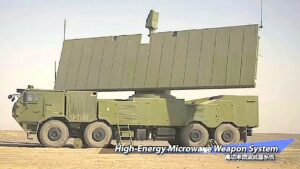
A huge truck-mounted system is one of at least three large mobile ground-based high-power microwave directed energy weapons, primarily intended to down drones, at this year’s Zhuhai Airshow. This underscores a global explosion of demand for counter-drone capabilities, as well as China’s steady progress in the development, fielding, and exporting of microwave and laser directed […]
Partnership Focuses on Safe and Efficient UTM Integration for BVLOS Operations Matternet, known for its urban drone delivery services, has entered a strategic partnership with ANRA Technologies to enhance airspace management for its drone networks. This partnership aims to support Matternet’s recent expansion of home delivery services and enable safe Beyond Visual Line of Sight […]
Partnership with Apian and NHS Trust Enhances Patient Care through Efficient Drone Logistics Wing, in collaboration with Apian and Guy’s and St Thomas’ NHS Foundation Trust, has launched a drone delivery service to transport blood samples in London. The service, now active between Guy’s Hospital and St Thomas’ Hospital, aims to improve care for patients […]
New collaboration combines SkyDrive’s eVTOL expertise with FEAM Aero’s extensive line maintenance network, paving the way for regional air mobility integration across U.S. aviation systems. by DRONELIFE Staff Writer Ian J. McNabb Japanese eVTOL developer Skydrive recently announced a new strategic partnership with F&E Aircraft Maintenance (Miami), LLC to provide a framework for future eVTOL […]
Investment in San Leandro Facility Aims to Strengthen Domestic Supply Chain and Deliver 200 MWh of High-Performance Drone Batteries by DRONELIFE Staff Writer Ian J. McNab Lyten, a San Jose-based materials company focused on the battery space, announced today that it will acquire Cuberg’s San Leandro lithium-metal battery manufacturing facility and cell making equipment. Lyten […]
I’ve been covering the drone industry for more than 10 years, and I’ve heard enough buzzwords to fill a small novel. “Disrupt,” “revolutionize,” “game-changer,” “cutting-edge,” “innovative,” “paradigm-shift” – these words seem to be as ubiquitous in the drone industry as drones themselves.
With the rise of AI, the problem has only gotten worse. I get pitches about companies that use “a stacked agent architecture, generative AI and AI-on-the-edge to enable true drone autonomy operations.” I’ve had public relations professionals gloat about how their clients “leverage AI technology to manage end-to-end drone operations, ensuring mission success in dynamic environments.”
The problem? I have no idea what they actually do and why it’s helpful. I’m guessing you, dear reader, don’t either.
3 reasons why you need to stop using buzzwords to describe your drone company
1. Buzzwords suggest your product isn’t all that interesting
If you need a buzzword to explain what you do, it’s probably not worth explaining. Let me illustrate this very thing. I asked ChatGPT to describe my job in as many buzzwords as possible. The only information I offered it? That I was a “a blogger who writes about and reviews drones.
Here’s what ChatGPT spit out:
As “The Drone Girl,” you’re an influential content creator in the fast-evolving UAV (unmanned aerial vehicle) ecosystem, providing cutting-edge insights and in-depth analyses of drone technology. You deliver high-impact, data-driven reviews, elevating user engagement with immersive multimedia content, all while harnessing the latest in aerial innovation. Your platform synergizes with emerging trends like AI-driven flight automation, drone swarms, and regulatory compliance, establishing yourself as a thought leader and trusted voice in the drone enthusiast community. You empower both recreational and professional drone users with actionable intelligence, fostering a dynamic, future-forward conversation in the drone space.
It’s terrible.
Cringe courtesy of ChatGPT.
Had I told you what I actually do, it would be far more interesting than what ChatGPT wrote in buzzword form. (Hey, at least I think my life is interesting).
You get the point. Tell me what you actually do, rather than disguise it in buzzwords.
2. Buzzwords suggest you don’t know what you’re talking about
Maybe your product is actually interesting. Alas, buzzwords suggest that even you can’t explain what you actually do all day, or why your product is worthwhile. If you can’t articulate your work in plain language, how can you expect anyone else to understand it?
Maybe your product actually is interesting. Your buzzwords have done you a disservice in muddying the story.
3. Buzzwords contribute to public misunderstandings
Perhaps worst of all? Buzzwords create confusion and — potentially worse — distrust. The drone industry has long struggled with negative public opinion, largely because people just don’t get it. They see a camera and assume it’s spying on them, purely because they don’t actually know what the drone is doing or what data that camera is gathering. Lack of transparency around your drone project just adds to such misunderstanding — and negative public opinion.
So, ditch the buzzwords and start talking real talk. Explain your work in a way that everyone can understand. Be clear about the benefits and the risks. And stop pretending that every drone project is the next big thing.
To truly make an impact, focus on solving real problems (big or small!). Demonstrate the tangible benefits of drone technology. Be transparent about our operations, data collection practices, and ethical considerations. And most of all, build trust with the public.
Looking for custom help in pitching your drone business to press? Need some 1:1 support on your marketing campaign? Book an appointment with me on Intro. We’ll work through your marketing language and help tell the version of your story that’s actually interesting — not just a mess of buzzwords.

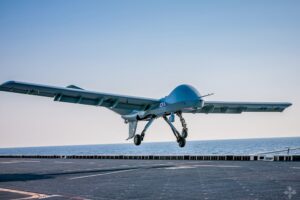 – General Atomics Aeronautical Systems, Inc. logged another aviation milestone on Nov. 12, 2024, when its Gray Eagle STOL aircraft took off from a South Korean warship and landed at a ground base – the first-ever such mission for an aircraft of this type. Working with our GA-ASI’s in-country partner, Hanwha Aerospace, Gray Eagle STOL […]